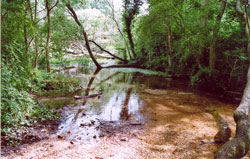
The Sandboils at The Moors SSSI and LNR, Hampshire
Example of a spring fed pond Before you attempt to construct, modify or restore a pond, you need to know where the water comes from.
1. Ground water ponds
Pond water can be fed from groundwater within the pond substrate. Where groundwater is permanently at ground level, your pond will be permanently full. Where groundwater rises and falls seasonally, you will have an ephemeral pond. Lining such a pond in attempt to keep water in all year round could lead to loss of the pond because the liner would prevent water rising up into the pond.
2. Surface water ponds
These are ponds dug into clayey or hard rocky substrates without groundwater and where water flows into the pond from off the surface of the surrounding area. Where it is suspected that some water may be lost through leakage into the underlying substrate, lining such ponds can help retain water.
3. In line ponds
These are ponds created by widening a pre-existing stream within its floodplain. As long as the inflows are maintained, and accumulated silt removed from time to time, the pond should remain.
4. Off-line ponds
These are ponds fed from a drain taken off a pre-existing stream and with an outflow drain taking water back again. It is important to maintain the inflowing drain in good condition and ensure that the source stream maintains a sufficiently high water level.
5. Spring fed ponds
These ponds may be have been dug into a wet spring fed area, or just downslope of a spring. It is important not to destroy the spring flows if such a pond needs restoration. Careful investigation may be needed.
6. High level ponds
These are purely artificial ponds without a natural source of water. Lined garden ponds are common examples. They need lining and the water levels will often have to be topped up from time to time in summer as water is lost through evaporation.
|