| Water Meadows are areas of deliberately flooded pasture intended to encourage grass growth and worked by creating a flow of water across the meadow using a system of channels (carriers) from which water flooded over the meadow controlled by a series of sluices and hatches. Water was led away from the meadow via further channels and returned to the river to be used again downstream. 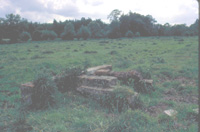
Bransbury Common, Test Valley
 |
The water meadow system was most characteristic of chalk streams such as the Avon, Test, Itchen and Kennet where water temperatures in the spring were higher than ground temperatures so encouraging growth of grass. The water also brought silt and nutrients which fertilised the grass swards.
A historical study of water meadows in Hampshire provided documentary evidence of deliberate flooding back to the early 14th century and the use of channels and sluices back to the early 17th century. Their use peaked in the 18th century. Today, there are few working water meadows, however there are a number of restoration projects.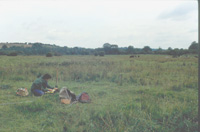
Examining Water Meadow
|
While water meadow creation may have reduced the botanical quality of meadows, they did encourage the survival of wet grasslands suited to a wide range of birds, amphibians and invertebrates that are now increasingly rare. Restoration projects now incorporate not only farming practices but also the need to conserve and enhance biodiversity and to restore historic landscapes.
Our earliest examination of water meadows were surveys of the geology and of the alluvial soils and peat deposits of water meadows along the whole length of the Test and Itchen valleys in Hampshire. Here it was possible to detect not only historic channels, but also those related to the late Ice Age history of the site where one-time natural channels are marked by thick beds of creamy precipitated calcareous tufa. As a result of these studies it was possible to examine how flooding had contributed to the deposition of silty and clayey alluvium over the earlier peat deposits. These studies are now being used as part of a wider study of the hydrology and hydrogeology of these two important river valleys.
Most recently, on the Kennet flood plain in Berkshire, we have investigated the hydrological system of a former irrigated osier bed, now Woolhampton Reed Bed SSSI (for English Nature), and we currently undertaking a study of wet meadows at Chimney in the upper Thames (for the Berkshire and Buckinghamshire and Oxfordshire Wildlife Trust - BBOWT). Both these projects aim to provide a means whereby the flood regime can be restored to benefit landscape and biodiversity.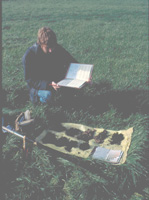
Water Meadow Soil Study
|
|