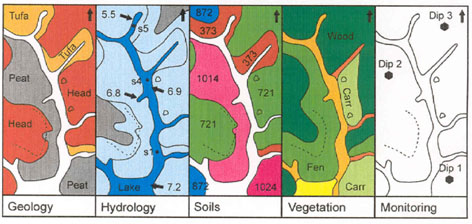
The techniques of hydro-ecology are powerful tools in:
- Wetland nature reserve recording, monitoring and management;
- Assessing the impact of development plans and projects;
- Environmental Impact Assessment of individual planning proposals.
Wetland Recording
Hydro-ecology allows you to structure your base-line recording system, how best to target those parts of the wetland habitat that need recording and deciding which are the most critical features to record.
Once you understand how water sources of different chemistry flow into, across, and out of your wetland habitats, you can devise a recording system that optimises recorder time and avoids wasting warden, volunteer and consultant time.
Wetland Monitoring
Once you have established a baseline, you will be able to identify those parts of the reserve that are most liable to change. You are then able develop a meaningful monitoring system. Such a system might cover changes in water flows and quality as well as changes in wetland plant and animal communities.
Changes can occur because of (for example): i) internal factors such as altered reserve management by creation of new ponds or changes to flooding regimes; and ii) external factors such as diversion of water flows and development outside of the site and changes in groundwater abstraction rates.
Wetland monitoring can identify abrupt or seasonal changes in: water chemistry and quality; stream flows, rates of soil wetting; the progress of improving habitat conditions and the detailed effects of external factors.
Wetland Nature Reserve Management Planning
Once you have a recording and monitoring scheme you can establish a habitat management plan based upon real knowledge. If you want to create an acidic pool, you will now know where your acidic water sources are. If you wish to reverse adverse changes in vegetation development, you will now be able to alter the flood regime to greatest effect.
Development Planning and Control
External factors such as housing and industrial development can have serious adverse effects on nearby wetlands. Hydro-ecology provides the means of assessing potential adverse effects and defining adequate zones of development constraint.
Government guidance indicates that local development plans should be the subject of environmental assessment, and where wetland sites are UK Sites of Special Scientific Interest local planning authorities are required to consider the effects of development planning upon them. Local planning authorities also have a special legal requirement to assess the effects of their development control plans and individual planning decisions upon designated international and European sites such as Ramsar sites, Special Areas of Conservation and Special Protection Areas.
Assessing the effects of development proposals
Hydro-ecology is the most powerful tool available to predict and monitor the effects of altered drainage direction and flow rates, changes in water chemistry, and interruption of groundwater movement, on wetland fauna and flora.
Avoiding wetland impact and monitoring
Once potential adverse effects have been predicted, schemes can be devised to prevent or reduce that impact and monitor the effectiveness of those schemes. Sustainable drainage is one such method, but adverse effects will only be avoided if the drainage scheme is targeted to the special requirements of individual wetland conditions. |
Copyright © The Environmental Project Consulting Group 2002 |
|